
My first marketing job was at Universal Music in Berlin.
On paper it was a dream. I worked in the international rock department — Metallica, Black Sabbath, 30 Seconds to Mars. Then rent took half my paycheck and I spent the month counting what was left.
The job had a name brand. The life didn’t.
Later I sold radio advertising in Mainz, broke the station’s first-year sales record, and the money got good. That was the more dangerous version. I could see the entire shape of the career from there — every promotion, every rung, all the way up. It was a ceiling with a salary attached.
Meanwhile I kept hearing stories about people who’d left Europe. Making more, working fewer hours, actually enjoying their lives.
I thought those stories were bullshit.
Then I almost became one by accident.
I left Germany at 25. A decade later I’m VP Growth Marketing at a German tech company — the same company that kept asking me to come into the office. The same company I said no to. Three times. They were fine with it, because I was hitting targets, shipping results, and working from Southeast Asia at European compensation.
Here’s what I learned: Most people aren’t failing to land remote jobs because of luck or timing. They’re failing because they’re making the same three mistakes I almost made.
Fix these, and everything changes.
Mistake #1: You’re Applying to Jobs, Not Building Positioning
I spent my first year in Southeast Asia sending applications. Good résumé. Decent cover letters. Ghosted constantly.
I was doing what everyone does: spray and pray. Hit indeed.com, filter for “remote,” customize a cover letter (not really), send. Repeat 50 times. Get 2 interviews. Get rejected.
The problem? I wasn’t positioning myself.
I was just a resume floating in a sea of other resumes.
Here’s what I didn’t understand back then: The remote job market doesn’t give a shit about your resume. It cares about one thing: are you different from someone they could hire in Berlin for the same price?
That’s it.
You’re competing against the entire German job market (or US, or wherever the company is). Your résumé says “Marketing Manager” and so do 5,000 other people applying to the same job.
What’s NOT on your résumé is your positioning.
Positioning is answering the question that actually matters: “Why should we hire you, in Southeast Asia, over someone local?”
And it’s not because you’re cheaper. (Spoiler: that’s a trap. Cheap hires get fired first when budgets tighten.)
It’s because you solve a specific problem they have that someone local can’t, or wouldn’t.
When I figured this out, everything shifted.
I stopped sending generic applications. Instead, I started showing my work publicly. Posting about what I was learning in marketing. Sharing wins and fails from the agency work. Building visibility around one specific thing I was good at.
Suddenly, job offers started coming to me. Not from applications. From people who’d seen my work.
The mistake most people make: They think the job application is the starting point. It’s not. Positioning is. You need to be known for something before you apply.
Mistake #2: You’re Chasing Salary, Not Solving Problems
I remember sitting in a coffee shop in Ho Chi Minh City, scrolling through remote job boards.
“€4,500 a month. That’s 2.5x what I made in Mainz. Apply.” “€6,000 a month. That’s 3x. Apply.” “€8,000 a month. That’s almost 4x. This one.”
I was optimizing for one variable: salary. And it kept backfiring.
Here’s why: Companies don’t hire you because you want more money. They hire you because you solve a problem.
When I finally landed a good role, it wasn’t because I negotiated hard or positioned myself as “hungry.” It was because I had a conversation with the hiring manager that went like this:
Him: “We’re growing our agency office in Southeast Asia, but we don’t have anyone who understands both B2B sales and marketing.”
Me: “That’s interesting. Because I’ve done both. And I see the gap you’re probably experiencing - sales and marketing are misaligned on what an actual lead looks like.”
Him: “Exactly. How would you fix that?”
And then I explained.
That conversation wasn’t about salary. It was about problem-solving. Salary came after we established that I could actually help.
Most remote job seekers lead with the wrong thing. They send an application that screams: “I want remote work and I want it to pay well.” That’s not a value proposition. That’s a wish list.
The mistake: You’re thinking about what you want (salary, freedom, flexibility). Employers care about what they need (solving their problems).
Flip the script.
Instead of “I want a remote job that pays 3x local salary,” ask yourself: “What problem do German companies have that I’m uniquely positioned to solve?”
Maybe it’s cross-cultural communication. Maybe it’s understanding Asian markets. Maybe it’s timezone flexibility. But there has to be something you bring that’s hard to find locally.
Find that. Lead with that. Salary follows.
Mistake #3: You’re Keeping It Private
This is the one that almost broke me.
I was learning constantly. Reading books on marketing (every weekend). Building skills. Taking on harder problems. Helping grow the agency from 5 to 37 people. Winning big clients.
And nobody knew about it except my boss and my team.
I was grinding in private, thinking that doing good work was enough. That eventually, someone would notice. A good résumé would speak for itself.
It didn’t.
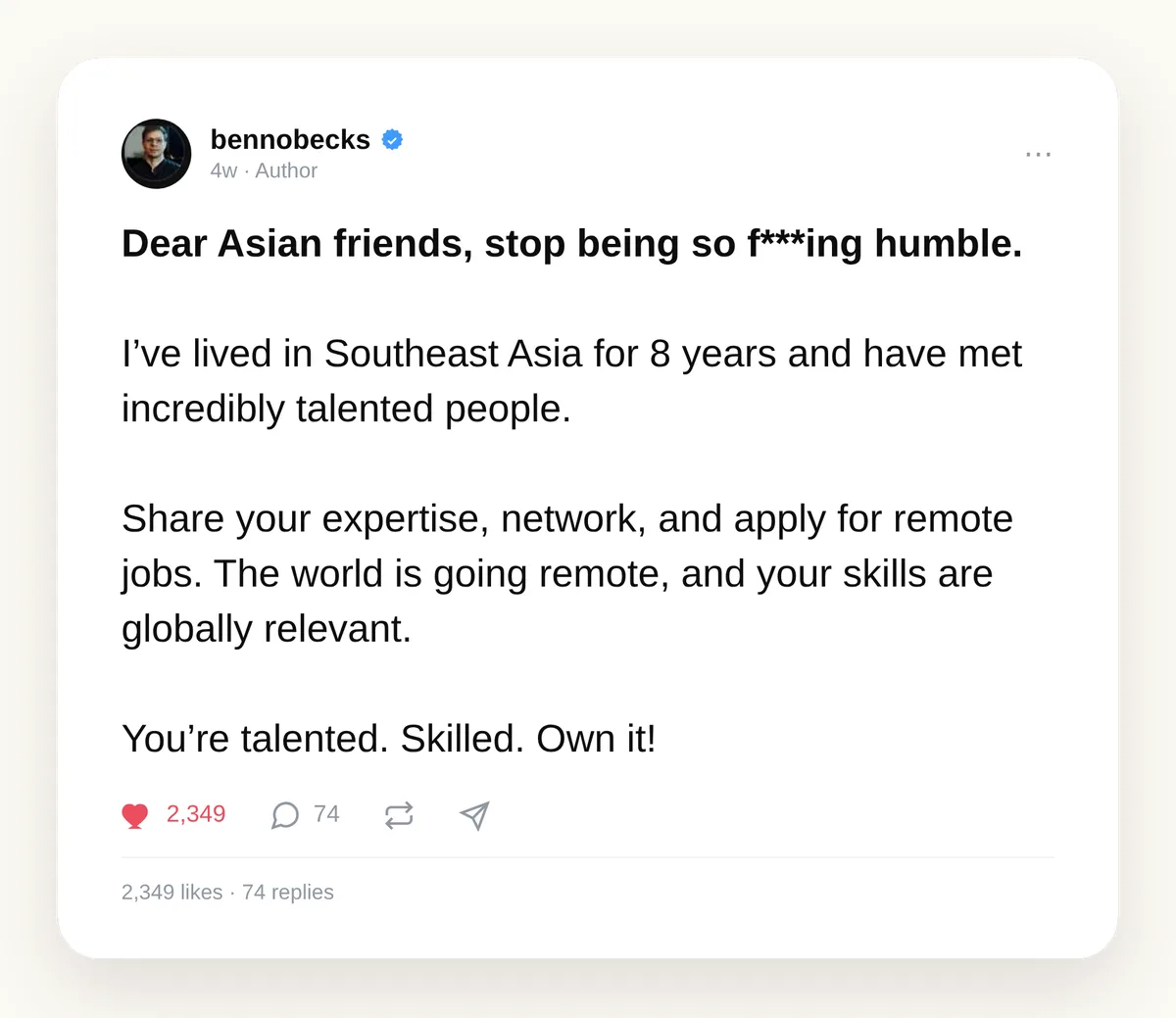
The turning point? Someone on LinkedIn saw a post I made about our yearly wins at the agency. It was a simple post - nothing fancy. Just talking about what we had executed and achieved. A CEO of another company in Singapore saw it, reached out, and offered me a role.
That job changed everything.
But here’s what’s wild: I almost never posted that. I thought, “Who cares? This is just internal stuff.”
Wrong.
The mistake most people make: They think visibility is ego. It’s not. It’s communication.
The best remote jobs don’t go to the most qualified people. They go to people with visible proof of competence.
That means showing your work. Publicly.
Not humble-bragging. Not fake inspiration. Not travel photos with laptops.
Real, specific proof that you can do what you say you can do.
Maybe that’s:
- Sharing what you learned from a project
- Posting about problems you solved
- Writing about mistakes you made and what you learned
- Commenting thoughtfully on others’ posts
- Showing your actual work (examples, case studies, results)
When companies see this, they don’t scroll past. They wonder: “Who is this person? Should we talk to them?”
That’s how you get hired for remote jobs that actually pay.
The Pattern
Look at these three mistakes together:
- You’re applying (waiting for opportunity)
- You’re chasing salary (focused on the wrong goal)
- You’re private (no one knows you exist)
They all point to the same problem: You’re optimizing for the old job market.
The old job market is: Find a job posting. Apply. Hope. Get rejected. Repeat.
The new remote job market is: Build positioning. Solve problems. Show your work. Get recruited.
Completely different game.
What Actually Works
After 10 years of figuring this out the hard way, here’s what I see:
The people who land remote jobs that actually pay aren’t the smartest. They’re not the most credentialed. They’re the ones who:
- Are known for something specific (not “good at marketing”—“expert in B2B demand generation”)
- Lead with the problem they solve, not the salary they want (“I help teams align sales and marketing” vs. “I want €5,000/month”)
- Show their work publicly (LinkedIn, Twitter, a blog, Threads—wherever their audience is)
That’s it.
Do those three things, and remote jobs start finding you instead of the other way around.
I’m not saying this because I’m special or lucky. I’m saying this because I’m not. I left Germany with zero plan and €10,000 in the bank. No master’s degree. No network. No connections in Asia.
But I eventually figured out the game. And it’s the same game for everyone.
The only question is: How long will it take you to figure it out?
One More Thing
If you’re serious about landing a remote job that actually pays, the first step is getting clear on what actually matters.
Most people are scattered across 10 goals. They want more money. Better work-life balance. Remote flexibility. A title upgrade. A nicer apartment. More time for family.
All valid. But they’re all competing for your energy.
That’s why I built CRUSH—a simple tool that maps your goals against effort and impact. So you can see instantly what’s actually going to move the needle, and what’s just noise.
It takes 5 minutes. And it changes how you prioritize everything after.
Get instant access to CRUSH (free)
Then tag me on Threads (@bennobecks) with your biggest realization. I respond to every question.
That visibility? That’s how you start landing remote jobs.
See you there.
Benedikt
P.S. These three mistakes aren’t theoretical. I see them every week from people who are almost landing remote jobs. The ones who fix them? They go from rejected applications to interview calls within 3 months. It’s the difference between trying to win the old game and playing the new one.