
You’ve sent forty applications. You’ve had no rejections.
That sounds like the same thing as forty rejections. It isn’t, and the difference is the whole point of this post.
A rejection means a human being read your application and said no. Silence usually means nobody opened it at all. Those are two completely different problems, and almost every piece of advice you’ll find online is aimed at the first one while you’re living the second.
So before you rewrite your CV for the forty-first time, let’s establish what is actually happening on the other end.
The statistic you’ve been told is not true
You’ve seen this line. It’s on every careers blog on the internet:
“75% of resumes are rejected by an applicant tracking system before a human ever sees them.”
It isn’t true. There is no study behind it, and there never was.
Here’s where it came from. On 4 March 2012, CIO.com published an article by Meredith Levinson called “5 insider secrets for beating applicant tracking systems.” It contains this sentence:
“These systems… kill 75 percent of candidates’ chances of landing an interview as soon as they submit their resumes, according to job search services provider Preptel.”
That’s it. That’s the source. You can still read it.
Three things about that sentence should bother you.
One: it doesn’t say what people claim it says. The original is about chances of landing an interview — the whole funnel, humans included. Somewhere between 2012 and now it mutated into “75% of CVs are never seen by human eyes.” The version you’ve read is a misquote of an already-unsourced number.
Two: Preptel sold the cure. Preptel’s business was software that tested your CV against applicant tracking systems. The scarier the number, the better their product looked.
Three: Preptel went out of business. They shut the service down on 30 August 2013, with a note explaining that “after running 3 years in the red” the model never worked.
A defunct vendor’s unsourced marketing claim from 2012 has been shaping how you write your CV in 2026.
I’m not being pedantic about this. It matters because the false version tells you the problem is your document and the enemy is a robot. Both halves are wrong, and believing them sends you off to spend another weekend fiddling with keywords.
What the real research says
There is a serious study on this, and people frequently misattribute the 75% figure to it.
Harvard Business School and Accenture surveyed 2,275 executives — at least 750 each in the United States, United Kingdom and Germany — for a 2021 report called Hidden Workers: Untapped Talent. What they found:
- 88% of employers agreed that qualified high-skilled candidates are vetted out of the process “because they do not match the exact criteria established by the job description.” For middle-skilled roles, that rose to 94%.
- Over 90% of employers use their recruiting system to filter or rank candidates before a human reviews them.
- 48% of employers screened out middle-skills candidates automatically for an employment gap longer than six months.
Read that carefully, because it’s a different story from the folklore.
Good candidates absolutely are being filtered out. But not by a mysterious robot making judgements. They’re filtered out by criteria that a human being wrote down, entered into a form, and switched on. The software is doing exactly what it was told.
That’s worse in one way and much better in another. Worse, because it’s deliberate. Better, because it’s predictable — and predictable things can be worked around.
What an ATS actually does
Let’s be precise, because precision here is worth real money to you.
An applicant tracking system is, mostly, a searchable database. Your application goes in. A recruiter later types a search — “Python AND fintech NOT intern” — and reviews whoever comes back. If your CV doesn’t contain the words they searched for, you don’t appear in the results. You weren’t rejected. You weren’t ranked last. You simply weren’t in the set.
That’s the honest version of “keywords matter.” Not because a robot is grading you. Because you have to be findable.
Auto-rejection does exist. But read what the vendors actually document.
Greenhouse’s support documentation describes auto-reject as a feature where “based on an applicant’s answer to a question, they will automatically be rejected.” It works only with Yes/No, single-select and multi-select question types.
Ashby’s documentation says the same: rules evaluate application form field answers at the moment of submission.
Neither of them parses your CV and hits delete. The trigger is the dropdown.
The question that actually ends it
Here’s the part nobody writing about this from London or San Francisco will tell you, because it doesn’t apply to them.
If you’re applying from Manila, Jakarta or Kuala Lumpur to a role at a US or European company, the thing that kills your application in milliseconds is almost certainly one of these:
- “Are you legally authorised to work in [country]?”
- “Which country are you currently located in?”
- “Will you now or in the future require sponsorship?”
You answer honestly. You hit submit. A rule fires. It’s over before the page finishes loading.
It wasn’t your CV. It was question four.
And that is a policy decision, made by a person, executed instantly — which means no amount of formatting, keyword-stuffing or rewriting will ever change the outcome on that particular application. You are not failing at the game. You are playing a game that was closed before you arrived.
The fix isn’t a better CV. It’s applying to companies where that question doesn’t exist, or where the honest answer isn’t disqualifying. I’ve written about how to tell those apart in remote-first vs remote-friendly companies — it’s the single highest-leverage filter you can apply to your own search.
Then there’s the volume problem
Even when there’s no knockout question, the odds have moved sharply against you in the last three years — and not because candidates got worse.
Greenhouse’s benchmark data, drawn from over 6,000 companies and more than 640 million applications:
| 2022 | 2025 | |
|---|---|---|
| Applications per job | 116 | 244 |
| Applications per recruiter | 146 | 746 |
| Time to fill | 43.6 days | 59.7 days |
Applications per recruiter rose 412% in three years. The number of recruiters did not.
LinkedIn reported roughly 11,000 applications submitted per minute on its platform in mid-2025 — a 45% year-on-year increase, driven largely by AI tools that let people mass-apply. In July 2026, Greenhouse’s CEO told Fortune the average posting on their platform now draws 254 job seekers, and that in the UK alone more than 1.2 million applications were submitted last year for fewer than 17,000 graduate roles.
Everyone is spraying. Which means everyone is drowning. Which means the pile gets processed faster and more brutally every quarter.
Ashby’s data across 54 million applications and 93,000 jobs puts a number on how fast: the median candidate who doesn’t get an interview is archived about six days after applying. Nobody wrote to you. But the file was closed within the week.
I’ve been on the other side of this. When a role goes live and the applications arrive faster than anyone can read them, nobody sits down and works through the pile fairly. They search. They ask the team who they know. They fill it from a shortlist that formed in the first 48 hours. The rest of the stack gets archived in a batch, and every one of those people spends the next month wondering what was wrong with their CV.
Nothing was wrong with their CV.
And now a machine interviews you
If you’ve made it past the form and found yourself talking to software, you’re not imagining how strange that is — and you’re now in the majority.
Greenhouse surveyed 2,950 active job seekers across the US, UK, Ireland, Germany and Australia in April 2026:
- 63% of US job seekers had already been interviewed by an AI — up 13 percentage points in six months.
- 70% said the use of AI wasn’t clearly disclosed beforehand. 21% only found out when the interview started.
- 51% who completed an AI interview never received any outcome at all.
- 38% had withdrawn from a hiring process specifically because it included an AI interview.
Then there’s the number I keep coming back to. In Greenhouse’s 2025 employer-side survey, only 21% of recruiters were “very confident” that their own systems weren’t rejecting qualified candidates. Eight percent said they had no idea what their algorithms prioritise at all.
The people running the filter don’t know what the filter is doing.
So when you sit there at midnight wondering what you did wrong: four out of five of the professionals on the other side aren’t sure the machine is getting it right either.
How to handle an AI interview
Practical, not outraged:
- It’s scoring structure, not charisma. Answer in clear, complete sentences. Say the role’s actual vocabulary out loud — the words from the job posting.
- Look at the camera, not your own face. Every instinct pulls the other way.
- Don’t wait for reactions. There aren’t any. Finish your thought and stop.
- Prepare six stories, not thirty answers. Situation, what you did, what changed. Most questions are a door into one of the six.
- You’re allowed to decline. Nearly four in ten candidates have. A company that won’t put a human in front of you before the final round is telling you something about what working there is like.
The formatting rules that are actually real
Most “ATS formatting” advice is invented. Here’s what survives scrutiny.
Real: single column. A 2025 study of 13,100 real CVs found that around 20% use non-linear, multi-column layouts that break the top-to-bottom, left-to-right reading order a parser expects. Two columns means the parser can read straight across — your job title stitched onto someone else’s date range. This one has evidence. Use one column.
Real: selectable text. If your CV is an image, or a scanned document, there is nothing to extract. Open your file and try to highlight a sentence. If you can’t, neither can the parser.
Real: keep the essentials out of headers and footers. Some parsers skip those layers. Your phone number and email belong in the body.
Folklore: “never send a PDF.” Greenhouse accepts .doc, .docx, .pdf, .rtf and .txt, with no stated preference. The parsing engines say the real PDF failure is a corrupted or image-only file, not the format.
Folklore: exotic fonts will get you rejected. They might parse badly. They will not trigger a rejection, because nothing about your document triggers a rejection.
That’s the whole list. If you’ve been maintaining a mental rulebook longer than five items, most of it was written by someone selling CV reviews.
What actually moves the needle
Everything above is the mechanics of a game with terrible odds. Here’s the part that changes the odds.
Referrals pass initial screens at 52%, against roughly 35% overall. That’s Ashby’s data across 54 million applications. Not a small edge — the difference between a coin flip and a long shot, achieved by the application arriving with a name attached.
And the arithmetic of direct outreach beats the arithmetic of applying. One of 244 applicants is a 0.4% shot at being read. One of maybe three people who emailed the hiring manager that week is a different universe. You’re not competing with 243 people anymore. You’re competing with a busy inbox, which you can win with a good subject line and one specific sentence about their problem.
So here’s the week’s work, and it’s the only thing on the list:
- Pick 10 companies. Not job posts — companies that already work remotely and that you’d want to work for.
- Find the person who runs the team you’d join. Head of Marketing. Engineering Manager. Not the recruiter.
- Send one short message each. Name a specific problem you can see they have, say how you’d own it, and attach nothing.
Ten of those beats a hundred applications fired into a job board. I’ve never once seen it go the other way — not in my own career, and not in anyone’s I’ve watched land a remote role from this side of the world.
A reader who did exactly this
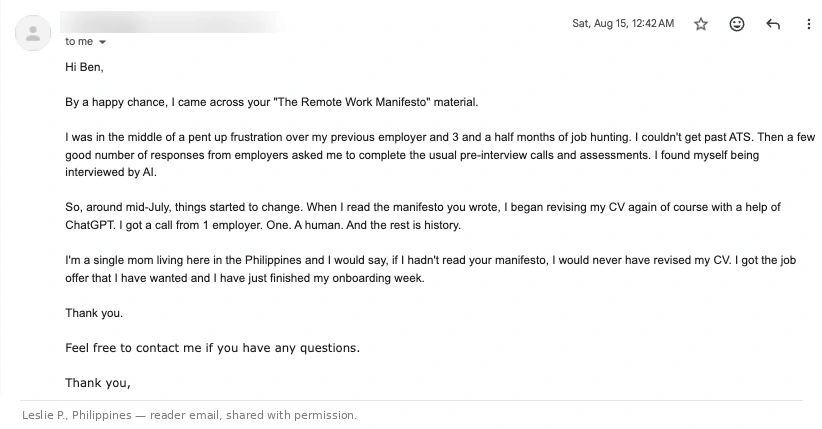
"When I was reading the old versions of my CV, I remember thinking, there's no impact here at all. It was basically a chronological record of my responsibilities. It told people what I did, but it didn't really show them the value I brought."
"So I stopped writing my CV as a list of responsibilities and started writing it as a demonstration of value."
"It didn't magically get me a job. I still had to do the work. But it made me rethink how I was presenting the experience I already had, and that changed everything."
The thing to take away
Your applications aren’t disappearing because you’re not good enough. They’re disappearing because you’re using the one channel where being good enough is invisible.
The silence isn’t a verdict.
It’s an address problem. You’ve been sending excellent letters to a building with no letterbox.
Stop rewriting the letter.