
Two people. Same job. Same skills. One earns $800 a month. The other earns $2,400.
The only difference is who signs the paycheck.
I watched this happen with friends in Hanoi. Talented marketers, better than half the people I’d worked with in Europe, convinced that $800 a month was simply “the rate here.” It wasn’t the rate for the work. It was the rate for the employer. The moment one of them started doing the exact same work for a company that paid on a global scale, the number tripled. Nothing about her skill changed overnight. Her salary was never a measure of her ability — it was a measure of who was paying.
That’s the remote salary gap. And once you see how it actually works, you can’t unsee it.
The gap is structural, not personal
Here’s the belief most Southeast Asian professionals carry: my salary reflects how good I am.
It doesn’t. Your salary reflects your employer’s revenue base.
When a local company hires you, it benchmarks your pay against the local market. This isn’t greed or disrespect. It’s structural. A company in Manila or Ho Chi Minh City earns local revenue, sets local budgets, and pays inside local salary bands. It genuinely cannot pay European rates, because it doesn’t earn European money.
So the ceiling isn’t your talent. The ceiling is the size of the pie your employer is cutting from.
Change the employer and you change the pie. A remote role at a company that pays every employee to one global standard breaks the anchor completely. Your geography stops being a discount code applied to your salary. This is the whole game: not working harder, not being smarter — reporting to a bigger balance sheet.
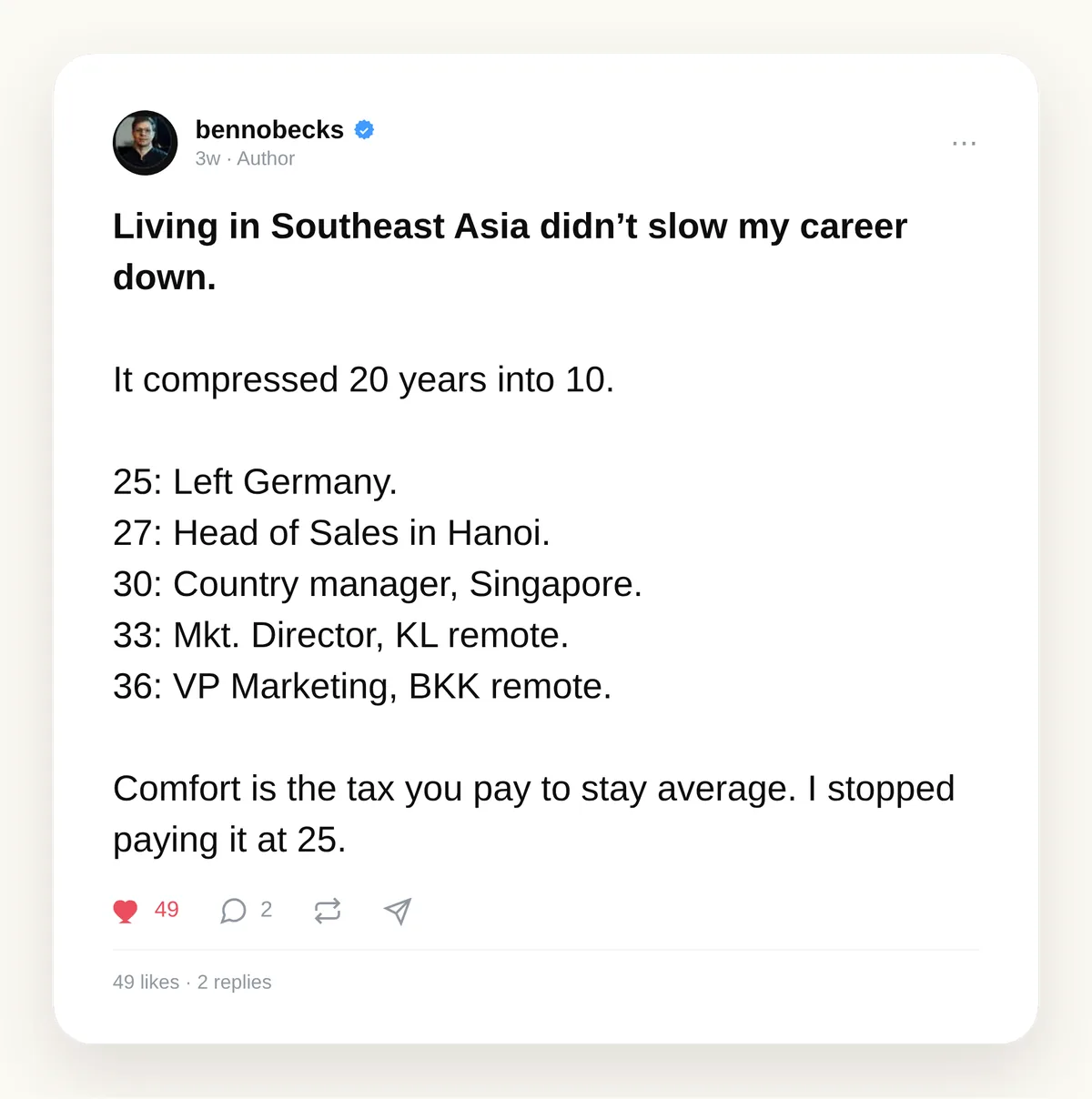
I’ve now spent 10 years in Southeast Asia. Three remote jobs, three promotions, all the way to VP Marketing at a German company — and I have never once sat in the same office as my boss. My pay has nothing to do with the cost of a coffee in Bangkok. It has everything to do with who I chose to work for.
The math: what “3x” actually looks like
Let’s make it concrete, because vague talk of “higher pay” is useless.
A mid-level marketing manager in Vietnam earns roughly $1,200–$2,000 a month locally. The same role at a European SaaS company, hired remotely, pays $4,500–$6,500 a month. Call it 3x.
But the raw multiple undersells it, because your costs don’t move. You’re still paying Hanoi rent, Hanoi groceries, Hanoi transport. So the gap doesn’t just raise your income — it lands almost entirely on top of your existing life.
Run the numbers on a $5,000/month remote salary in a SEA city:
- Local cost of living, comfortable: ~$1,200–$1,800/month.
- What’s left to save or invest: $3,000+ every month.
A local $1,500 salary in the same city might leave you $200 to save after expenses. The remote role doesn’t make you 3x richer. On the metric that actually matters — money left at the end of the month — it makes you 10x or more. That’s the part the “3x” headline hides.
This is what it looks like when your pay finally matches your skill instead of your postcode. It’s the single biggest financial lever available to a skilled professional in this region, and it requires no visa, no relocation, and no leaving your family.
Why global companies are hiring SEA talent right now
If the gap is this good, why does the opportunity keep growing instead of closing?
Because the demand is real and it’s rising. In PwC’s 2024 Asia Pacific Workforce survey, 77% of employers reported difficulty filling key roles. Western companies have run out of affordable local talent and have finally gotten comfortable with distributed teams after years of forced practice.
They are not looking to Southeast Asia for cheap labour. That framing is outdated and, frankly, beneath you. They’re looking for skilled, English-fluent professionals who can deliver at a global standard and who happen to overlap a few hours with the European or US workday. If that’s you, you’re not a discount. You’re the hire.
Where the gap is widest
The gap exists everywhere, but it’s not evenly distributed. Target the roles where remote-first, globally-paying employers cluster.
SaaS and tech startups
European and American software companies are the sweet spot. They’re almost always fully distributed, they pay on global scales by default, and they hire remote marketing, operations, and customer success people constantly. Start here.
Digital marketing and growth
International agencies actively compete for marketers who are fluent in English, know the SEA market, and can show data-backed results. Growth, performance, and content roles travel across borders easily because the work is measured in numbers, not desk time.
Operations and project management
Distributed companies live or die on operations people who can run async workflows across time zones. If you can keep projects moving without everyone being online at once, you are genuinely valuable to a remote team — and paid accordingly.
Customer success and account management
Strong B2B communicators with APAC experience are in short supply. Companies expanding into Asian markets need people who understand the region and can hold a client relationship. This role is often underrated and consistently well paid.
How to actually cross the gap
Knowing the gap exists changes nothing. Closing it is a process. Here’s what the people who cross it do differently — I go deep on each of these in the full system for landing remote jobs from Southeast Asia, but here’s the short version.
1. Target companies, not job boards. The best remote roles are filled through direct approaches to remote-first employers before they ever hit a public board. Build a list of 20 companies that pay globally and are already distributed. Go to them.
2. Reposition your CV for a global standard. A CV that reads “local hire” gets local offers. Reframe your experience around international scope, remote tools, and cross-border collaboration. Most SEA applicants get rejected on this alone — here’s exactly why, and how to fix it.
3. Refuse to anchor to local salary. When the number comes up, name the international market rate, calmly and without apology. If you open with your local salary, you’ve handed them a discount they never asked for. The gap only closes for people who refuse to price themselves locally.
4. Treat each application as a project. Not spray-and-pray. Research the company, tailor the materials, and show up like someone who already operates at their level. Ten focused applications beat a hundred generic ones.
Your move this week
Don’t try to change your life by Friday. Do one thing.
Pick your role. Open a fresh document. Find five companies — European or American, remote-first, in your function — that would plausibly hire someone with your skills. Then look up the real remote market rate for that role in the West.
Write that number down and sit with it. That number is what your work is worth to the right employer. Everything from here is just building the bridge from your current salary to that one.
The gap isn’t a wall. It’s a door most people never think to try. You’ve been standing in front of it, assuming the local rate was the only rate. It never was.