
You can do everything else right — the positioning, the outreach, the interviews — and still lose the whole thing in a single conversation.
The salary talk is where the remote-from-Southeast-Asia dream is actually won or lost. It’s the moment a European company decides whether you’re a global hire who happens to live in Hanoi, or a cheap local they found a clever way to reach. Same person. Same skills. Two completely different numbers — and the difference is almost never the work. It’s the conversation.
This is the full playbook for that conversation.
The one belief you have to kill first
Before any tactic, one belief has to go, because every mistake in a salary negotiation grows from it:
“My salary is set by where I live.”
It feels like gravity. It isn’t. It’s a pricing decision someone else made, in a meeting you weren’t in, and then handed to you as if it were weather. A campaign that earns a company €500,000 earns them €500,000 whether you built it from Berlin or from a co-working space in Da Nang. The revenue doesn’t know where you sat.
The frame that replaces it:
“My salary is set by what I deliver. Geography is a frame someone chose — and frames can be refused.”
Everything below is how you refuse it in practice. (For the deep version of this specific fight — the “we pay local rates” line and exactly what to say instead — see the full breakdown here.)
Before the room: the negotiation you win before it starts
Most salary negotiations are decided before anyone says a number. Do this work first.
Research the European band, not your local one
You cannot anchor to a range you don’t know. Before the conversation, find what the role actually pays at a European company — check public salary data, comparable listings, and what peers in that market earn. You’re building a target you can defend, in the currency the value is created in.
Decide your number in advance — and make it a range with a floor
Walk in with three figures already set: the number you’d be delighted with, the number you’d accept, and the floor you’d walk away below. Deciding these live, under pressure, is how people talk themselves down in real time.
Write your three sentences and rehearse them until they’re boring
The refusals below fail when they arrive as an improvised, slightly aggrieved speech. They land when they sound like admin. Write them out, say them aloud ten times, and get them boring before you ever need them. The conversation where you need these lines is not the conversation to invent them in.
The anchor decides everything
If you take one thing from this post, take this: the first real number in the room becomes the gravity everything else orbits. Your entire job in the early conversation is to make sure that number is their European budget, not your past salary.
Never volunteer your current or local number
When they ask what you currently earn — and they will, often disguised as friendly admin — do not answer it. The moment they have your current figure, the negotiation is about your past instead of their budget, and every number afterward gets measured against a salary that describes a job you’re leaving, in a market you’re leaving.
“I’d rather not anchor this to my current role — different market, different scope. What’s the range you’ve budgeted for this position and the outcomes attached to it?”
No confrontation. No number. You’ve priced the role instead of your postcode.
Refuse the postcode when it appears
When it comes — “our rate for someone in your region is lower” — don’t argue that they’re wrong to have a benchmark. Argue that it’s the wrong benchmark for this hire.
“I understand you have a local benchmark. But you’re not buying my location — you’re buying my output, and my output isn’t local. It’s the same work your Berlin team does, to the same standard. The question isn’t where I sit. It’s what I deliver and what that’s worth to the business over the next year.”
Calm reads as a professional stating a price. Indignation reads as someone who can’t afford to walk. Stay calm.
Naming the number
At some point you have to say a figure. Anchor it to the top of the European band you researched — the delighted number, not the acceptable one — because the number you name is the ceiling of everything that follows.
“Based on the scope and the European market for this role, I’m looking at a range of [X] to [Y].”
Then stop talking. The most expensive mistake at this moment is filling the silence by negotiating against yourself.
Two levers most people leave on the table
The contractor multiple
If they offer a contract instead of employment, your rate should go up, not down. As a contractor you absorb your own tax, benefits, paid leave, and severance risk, while the company saves 20–40% in employer-side costs and gains the flexibility to scale you up or down. Every one of those savings is theirs; every one of those protections is now yours to buy.
So the arithmetic is simple: a contract rate sits above the equivalent employee salary. The working benchmark is 1.4 to 1.6 times. Most people hear “contract” and quote less — handing over a 40–60% discount and carrying all the downside for free.
There’s a way to say this out loud that keeps it matter-of-fact instead of combative — you frame the premium as their saving, not your demand, so the number sounds like arithmetic rather than a fight. The exact wording I use for that line is one of the salary scripts in the Remote Job Application Toolkit.
The currency you’re paid in
Invoice in euros or dollars, not your local currency. Paid locally, your real income rides the exchange rate — if your currency strengthens you take a pay cut you never agreed to. Tie your pay to the currency of the value you create, not the city you sleep in.
Scenarios: the exact moments, and what to say
Scenario: “So, what are you earning currently?”
Treat it as the first offer disguised as admin — because that’s what it is. Redirect to their budget (script above). Do not give the number, not even “to be transparent.”
Scenario: “We usually pay local market rates for the region.”
The postcode refusal (script above). Name the work, not the location, and put the question back on what the output is worth to the business.
Scenario: “Would you ever consider relocating to where we’re based?”
Late in the process this sounds like a loyalty test. It’s a pricing question in disguise.
The move is to answer it with a question of your own: keep the door open, but make clear that relocating means reopening the package, because your low cost of living was baked into the current number. Then ask what that relocation package would look like — even if you’ll never move. If they put a figure on it, they’ve just told you what you’re worth with the cheap-location discount stripped away. That number is your true market value inside that company, and most people never ask, so they never find out. (The exact way to phrase this without sounding like you’re angling to leave is scripted in the Toolkit.)
What the numbers realistically look like
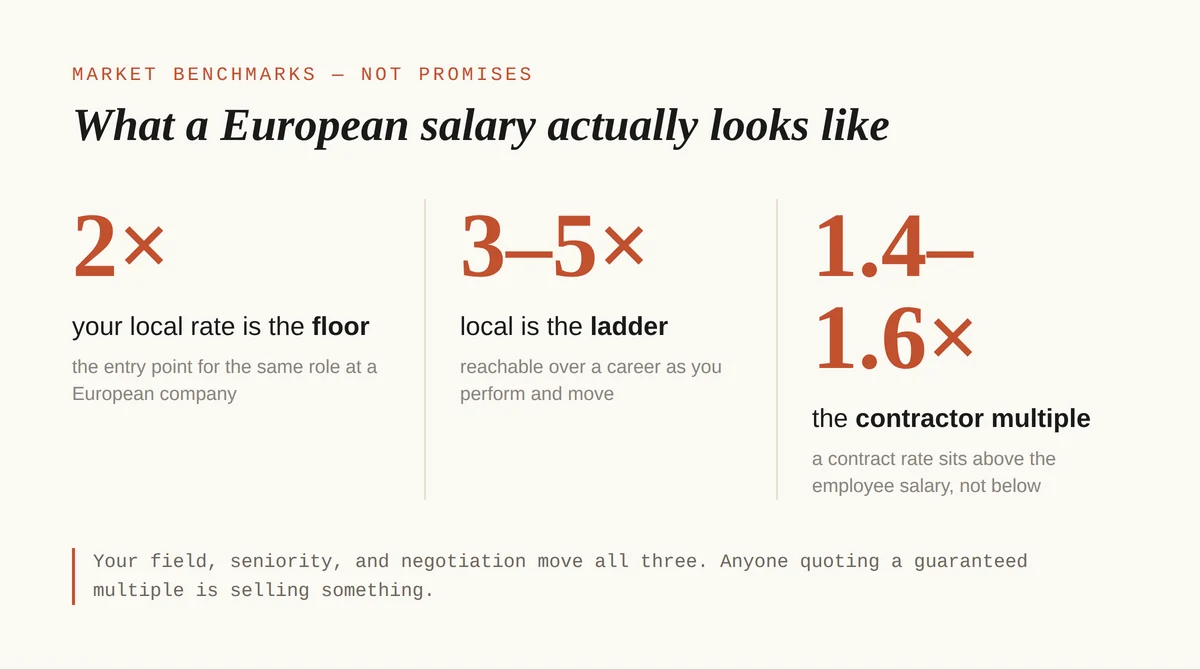
Market benchmarks, not promises:
- Double your local rate is the floor for the same role at a European company — the entry point, not the ceiling.
- Three to five times local is the ladder — reachable over a career as you perform, get promoted, and move between companies.
- 1.4 to 1.6× the employee salary is the contractor multiple — non-negotiable arithmetic, routinely negotiated away.
Your field, your seniority, and your negotiation move all three. Anyone quoting you a guaranteed multiple is selling something.
The whole game, in one sentence
You are not underpaid because of where you live. You’re underpaid because someone priced your postcode and you didn’t have a sentence ready.
Write your sentences. Rehearse them boring. Anchor to the role, refuse the location, charge for the contract, and ask the relocation question you never intend to act on. That’s the conversation — and it’s the one that turns a local salary into a European one, from exactly where you’re sitting.