
You think you’re competing with the Berliner whose job you’d happily do for a third of the price.
You’re not. You’re competing with someone in Kraków — and they’re beating you before you’ve finished writing your cover letter.
This is the most uncomfortable thing I can tell you about landing a European remote job from Asia. It’s also the most useful, because once you see who you’re actually up against, you finally know what to change.
The comfortable lie you’ve been sold
The pitch nearly every guide teaches goes like this: “You do the same work as a German professional, for a fraction of the cost. That’s your edge.”
It’s true. It’s also answering a question the employer isn’t asking.
Because when a European company decides to hire someone remotely, they don’t open the search to the whole planet and rank everyone by price-per-output. They reach for the path of least resistance first. And the path of least resistance is not in Manila or Hanoi.
The shortlist you’re not on
When a German company opens a remote role, the first names that land on the recruiter’s desk look like this: Warsaw. Kraków. Bucharest. Belgrade.
Here’s why Eastern Europe wins by default:
- Same time zone. A candidate in Poland is on Central European Time. Their working day is Berlin’s working day. Zero friction, full overlap.
- Inside or next to EU law. No visa question. No untangling whether you can even employ this person. For an EU-based company, hiring a Pole is administratively boring — which, in hiring, is a compliment.
- Already cheaper than a German. They don’t need you to undercut a Berlin salary. They can undercut it without leaving the EU.
And this isn’t a hunch — it’s where the demand is pointing. In KPMG’s German CEE Business Outlook 2026, 63% of the German companies surveyed said they expect Central and Eastern Europe to contribute more to their turnover over the next five years — with low labour costs among the named reasons.
And the direction of travel backs it up. Deel’s 2026 global-hiring data — from one of the largest cross-border payroll platforms — shows the best-funded companies now optimise remote hires for proximity, language, and top available talent over raw labour cost. Read that twice, because it’s the whole game: the thing most guides tell you to lead with — being the cheapest — is exactly the thing they’ve stopped optimising for. Closeness is winning. Which is precisely why the shortlist starts next door.
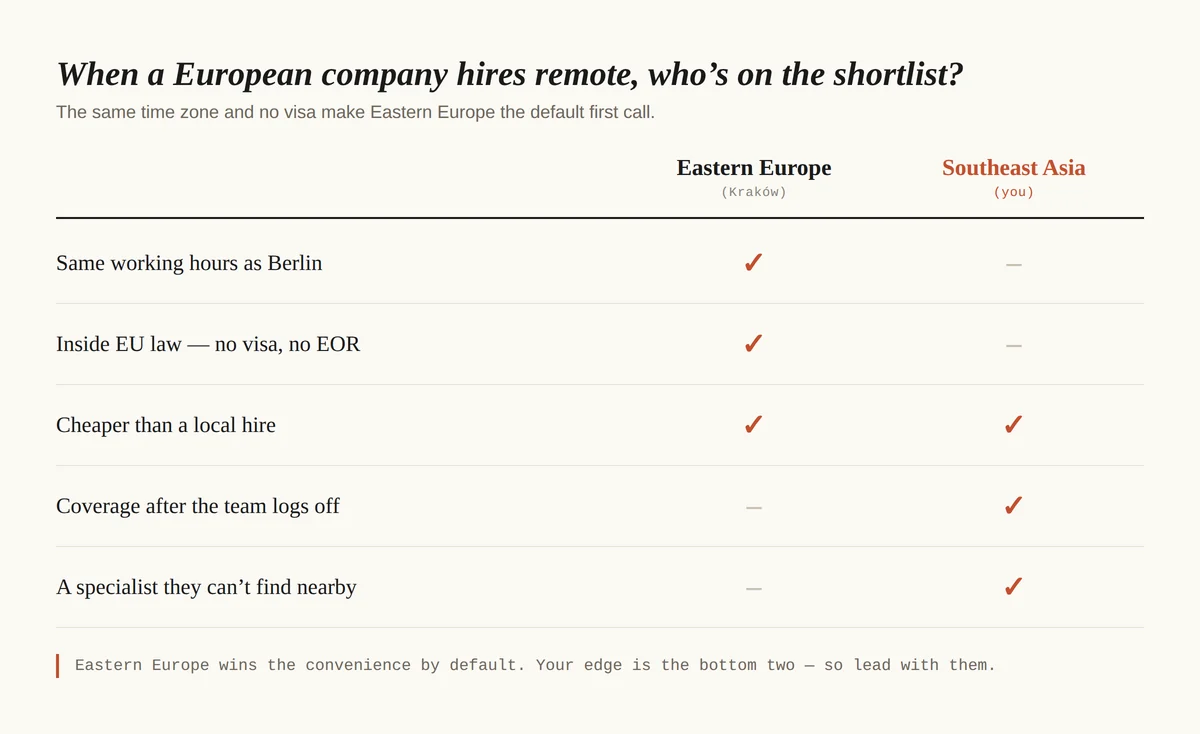
So read the board again. The Manila candidate isn’t competing with the expensive, office-bound German. They’re competing with a Pole who is cheaper, closer, and legally frictionless. That’s the opponent. And if your entire pitch is “I’m cheaper than a German,” you’re answering a question that was already settled two countries to the east.
I’ve watched this from the other side of the desk. When the brief is “hire remote,” the shortlist fills with Central and Eastern Europe long before anyone scrolls further out. Not because those candidates are better — because they’re easier. That’s the wall you’re actually hitting, and nobody in this niche will tell you it’s there.
So how do you actually win? Three levers Kraków doesn’t have.
The good news hiding inside the bad news: the moment you know the real opponent, you know exactly what to emphasise. And on all three of the things that matter most, you have an edge a Polish candidate structurally can’t match.
1. The async second shift — your disadvantage is your only moat
A candidate in Kraków shares Berlin’s 9-to-5. That means they offer the company no coverage advantage at all. Everyone logs off at the same time.
You don’t. When the Berlin team closes their laptops, you’re mid-afternoon. Work handed off at the end of their day is finished and waiting before their next coffee. That’s not a delay to apologise for — it’s a second shift the company isn’t paying extra for, and it is the one thing the Polish candidate cannot offer no matter how good they are.
Stop hiding the time gap. Invoice for it:
“The time difference means you effectively get coverage around the clock — I pick up where your team leaves off, so things move overnight instead of waiting for morning. For anything time-sensitive, that’s a real edge over hiring inside the same time zone.”
2. The cost gap — framed as investment, not a discount
Yes, you can come in below an Eastern-European hire. No, that shouldn’t be your headline.
The cheapest option in any hiring process is also the first one cut and the least trusted. If your whole case is “lowest number,” you win the wrong roles at the wrong companies and you’re gone at the first budget review.
Frame it the way a senior hire would: same output, delivered reliably, and the cost difference is something the business gets to reinvest — in more scope, a bigger mandate, a longer runway. Let the number be a pleasant fact near the end of the conversation, not the pitch at the start. (When it’s time to actually name that number, here’s how to negotiate a European salary from where you sit.)
3. Specialisation — make geography stop mattering
A generalist loses to the closer generalist. Every time. If you and a Kraków candidate both describe yourselves as “a marketer” or “a developer,” they win on proximity and you never get a look.
The counter is to be so specific that location stops being the deciding variable. Not “marketer” — “the person who’s run paid acquisition for B2B SaaS across three European markets.” Not “developer” — “the one who’s rebuilt billing systems on Stripe for subscription businesses.” When you’re the person who’s clearly solved this exact problem before, the shortlist reshuffles around expertise, and the Pole’s time-zone convenience stops being enough.
Two situations, and what to do in each
Scenario: The job description doesn’t mention location at all
Assume the shortlist skews Eastern Europe and position accordingly. Don’t open with “I’m based in Vietnam” as an apology — open with the specialisation and the coverage. Lead with the two things that make geography irrelevant, and let your location be a detail they discover after they want you.
Scenario: They tell you “we usually hire within Europe”
This is the exact moment the async lever earns its keep:
“That makes sense for a lot of roles. The one place it can work against you is coverage — a team all in European hours goes dark at the same time. I’m several hours ahead, so I extend the working day rather than duplicate it. For the parts of this role that are time-sensitive, that’s usually worth more than being in the same office hours.”
You’re not arguing with their policy. You’re handing them a reason the policy might be costing them something.
You’ve been fighting the wrong opponent
Everything changes when you stop picturing the German and start picturing the Pole. The German was never the competition — too expensive, too office-bound, not even in the running for the remote req. The real contest was always against the candidate who’s cheaper, closer and frictionless.
You can’t beat them on convenience. You beat them on coverage, on cost-as-investment, and on being the specialist they can’t find next door. Aim your whole pitch at that opponent, and for the first time you’re competing in the race that’s actually being run.