
There is a sentence almost every candidate in Southeast Asia writes to a European employer. Some version of:
“I know I’m several hours ahead, but I’m happy to make myself available for your meetings.”
It reads like flexibility. It lands like a confession.
You have just told them, before they asked, that your location is a defect — and that you’ll absorb the cost of it personally. You’ve opened the negotiation by conceding the only structural advantage you had.
Stop writing that sentence.
I said no to the office three times
The company I work for now is a German tech company. I have never sat in their office. Over three separate conversations, my boss asked me to come in. I said no each time.
I was promoted anyway. Over about two and a half years the title moved from Director to VP.
I don’t tell that story to be impressive. I tell it because of what it proves — and what it doesn’t. It does not prove that saying no is clever, or that you should be difficult. It proves something narrower and more useful:
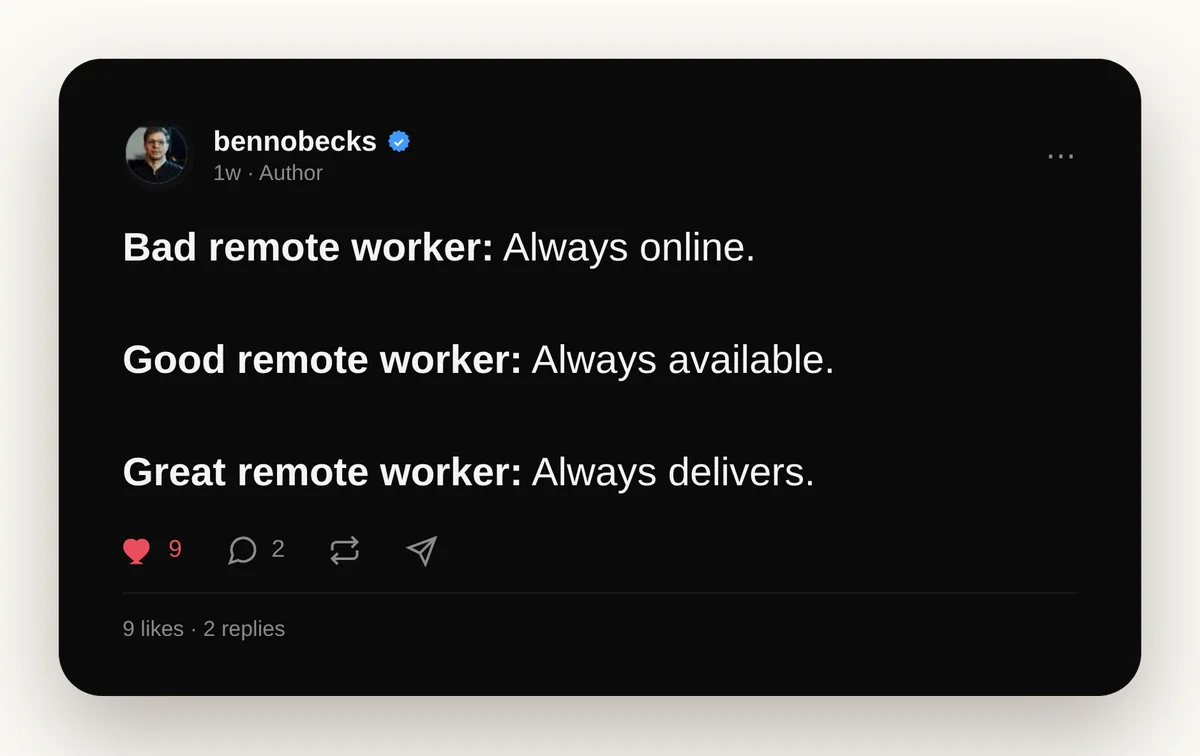
In a remote relationship, presence was never the currency. Output is.
They kept me and promoted me because the work landed. Had the work not landed, no amount of showing up would have saved it — it would just have taken longer for everyone to notice.
That’s the whole thing. Face time is a proxy for contribution. When you’re 9,000 kilometres away, the proxy stops working and only the real thing counts. Most people experience that as a threat. It’s the opposite: it’s the fairest deal you’ll ever get.
The belief that has to go
Here’s the frame nearly everyone carries into these conversations:
“My timezone is a problem I have to compensate for.”
So they compensate. They offer European hours. They promise availability at 11pm. They apologise in the first paragraph of the cover letter. They arrive pre-discounted.
Here’s the frame that replaces it:
“My timezone is a second shift they aren’t paying for yet.”
Look at what actually happens with a 5–7 hour gap. Something lands at the end of the day in Berlin. Their team goes home. You pick it up. It’s finished and sitting in the inbox before Berlin has had its first coffee.
That is not a delay. That is coverage they cannot buy locally at any price.
The most senior remote people I know never apologise for their timezone. They invoice for it.
Five moves
1. Delete the apology
Go and look at your CV, your LinkedIn summary, and the last outreach message you sent. Find every sentence that pre-emptively manages your location. “Despite the time difference…” “I’m flexible on hours…” “I can adjust to your schedule…”
Delete them. All of them.
Nobody asked. You volunteered a weakness that only exists because you named it.
The common mistake: believing this is honesty. It isn’t — it’s pre-negotiation. You’re conceding a point before anyone has raised it, and you can’t un-concede it later.
2. Sell the second shift
When the gap does come up — and it will — don’t defend. Reframe:
“There’s an async advantage here that’s easy to miss. I’m five to seven hours ahead of your HQ. When something lands at the end of your day, I’m picking it up while your team sleeps — so the deliverable is sitting in your inbox before Berlin has had its first coffee. You effectively get a second shift on the clock, not a delayed one.”
Read what that does. It doesn’t argue that the gap is acceptable. It argues the gap is why you’re valuable. Those are different conversations, and only one of them ends with you getting paid properly.
The common mistake: offering full timezone alignment to close the deal. Some overlap is fine — two or three hours, agreed deliberately, on purpose. Volunteering your whole day is how you end up doing European hours on a discount, resentful within six months.
3. Answer the fear they won’t say
Underneath the timezone question is a worry the hiring manager will rarely voice: remote and distant means slow and disconnected. Things will go missing. I’ll be chasing.
You can’t rebut a sentence nobody says. So answer it structurally, before it’s asked — by being specific about how work moves rather than promising to be responsive:
“Here’s how I’d run it: everything lands in writing, decisions get documented where the team can find them, and anything blocking you gets picked up at the start of my day, which is the middle of your night. You’d never wait a full cycle on me.”
You’ve replaced a vague fear with a visible mechanism. Fear survives on vagueness.
4. Build your hallway
This is the part almost nobody understands until it’s cost them a promotion.
When you’re remote, you are not in the room where impressions form by osmosis. Your colleague in Berlin gets credit in hallway conversations you will never be part of, in kitchen chat you will never hear, in the ninety seconds after a meeting ends when someone says “she handled that well” and the manager files it away.
You get none of that. Not because anyone is against you — because you’re not there.
So build the substitute:
Your written record is your hallway.
Every quarter, in writing, ask your manager the same question: “What do I need to do to grow into the next level?” Deliver exactly that. Then get the acknowledgement in writing — “Yes, you’re on track.”
Stack three or four of those and the eventual raise stops being a request. It becomes the only consistent conclusion of a paper trail your manager helped build. Saying no at that point means contradicting their own written words, and people hate doing that.
That’s not bureaucracy. It’s how a remote person stays visible, on the record, and impossible to overlook when the budget conversation happens in a room they’re not in.
The common mistake: doing outstanding work and assuming it speaks for itself. It doesn’t. It can’t. Nobody is in the hallway saying your name.
5. Build a hallway outside the company too
The internal paper trail handles one problem: being overlooked by the people who already employ you. It does nothing for the larger one.
When you’re remote, you’re invisible by default — not just to your manager, but to the entire market. The recruiter who would have called doesn’t know you exist. The offer that would have given you leverage in your next review never arrives. The speaking invitation, the introduction, the “we’re hiring, and I thought of you” — none of it reaches someone with no public footprint.
And here’s why that isn’t a separate topic: outside leverage is what makes internal conversations easy. The person who has options negotiates differently. Not by threatening — you never have to mention it — but because it changes what you’re willing to hear. Everyone can tell the difference between someone asking and someone choosing.
So publish something. Not a personal brand, not daily posting, not a content strategy. A visible body of work that lets a stranger verify you in ten minutes without a single reference call. Write about what you actually did and what it produced.
Trust is slow. Proof is fast.
Done properly this isn’t self-promotion — it’s the same thing as the documented yes, just pointed outward. Your written record is your hallway inside the company. Your public footprint is your hallway in the market. Remote work removed both by default. You have to build them back deliberately, and almost nobody does.
The common mistake: waiting until you need a job to become visible. Visibility takes six months to compound and job searches take six weeks. Build it while you don’t need it — that’s the only time it’s cheap.
Do this today
Open the last three things you sent a potential employer — CV, LinkedIn summary, most recent message.
Count the apologies. Every sentence that manages, excuses, or pre-emptively compensates for where you live. Most people find between two and five and are genuinely surprised, because they read as professionalism.
Delete every one. Replace exactly one of them with a single line about the async advantage — the second shift, in your own words, not mine.
Then write the one-sentence version of your quarterly question and put a recurring reminder in your calendar for the first Monday of the next quarter. That’s the whole system. It takes four minutes to set up and it compounds for a decade.
Nobody is in the hallway saying your name
You are not behind. You are ahead — by five to seven hours, on a clock they can’t buy locally.
The people who struggle remotely aren’t the ones far from the office. They’re the ones who never stopped treating distance as something to be forgiven, and so were never in the room, and never built the record that would have stood in for it.
Stop apologising for the gap. Start invoicing for it.