
Every week someone lands in my replies with the same worry: “Isn’t remote work dying? Everyone’s being forced back to the office.”
They read the headline. They didn’t read the dateline.
Because almost every one of those headlines has an American company’s name in it — and you are not applying to that company. You’re applying to Europe. And the panic that’s shrinking your target list is happening on a different continent.
Let me show you the gap between what the headlines say and what the data says, because it changes who you’re willing to apply to.
Where the “everyone’s going back” story actually comes from
It comes from a specific, narrow, very loud group: US trophy corporations.
Amazon went to five days in January 2025. JPMorgan followed in March. Dell too. Those are real, and they’re the stories that travel. What doesn’t travel is the context around them:
- In aggregate, US home-based work has plateaued, not reversed — it’s been sitting at about a quarter of all paid workdays, roughly five times the pre-pandemic rate, and holding steady since 2023.
- Office occupancy across major US cities has settled at about half of the pre-pandemic baseline and stayed there — even the post-pandemic record week barely cleared 56%. The headline says record; the number says structurally halved.
- The companies mandating five days don’t even seem to believe it themselves — several are leasing coworking and flex space to absorb the mandate rather than committing to permanent offices.
So the “great return” is a handful of names making an outsized amount of noise. Real, but not representative.
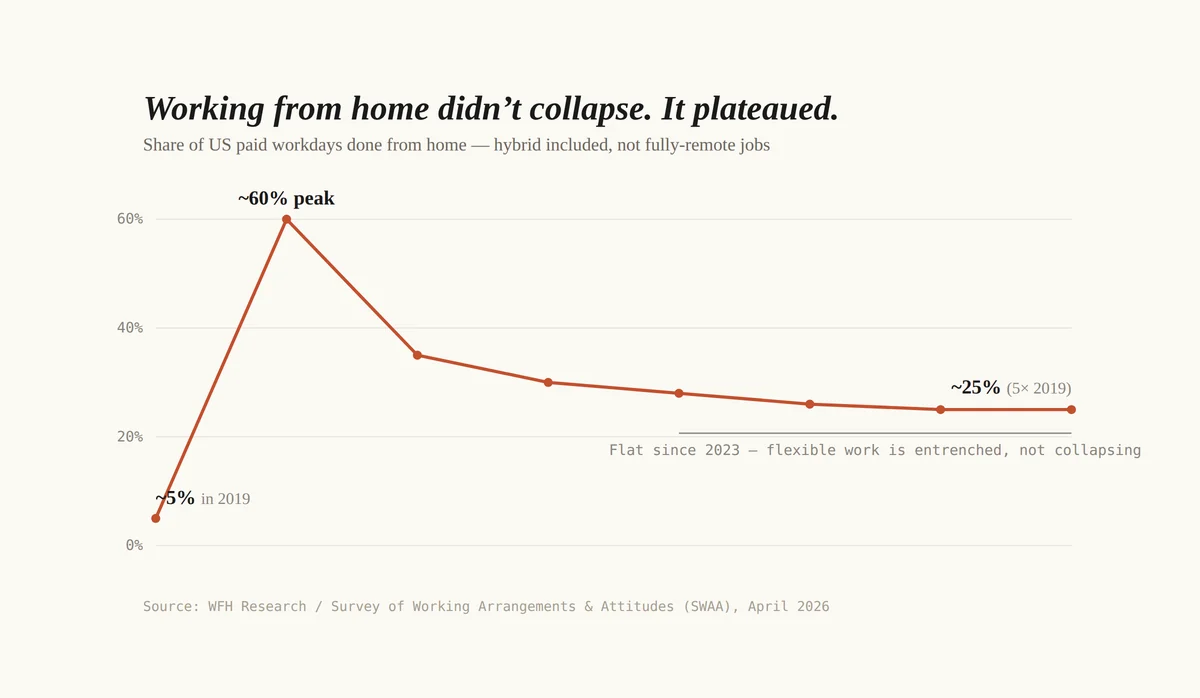
One honest note on that number, because it decides how you should read it. It measures days worked from home — and that includes hybrid. Someone in the office three days a week and home two is inside that 25%. So don’t read it as “a quarter of jobs are fully remote.” Read it as what it actually is: flexible, home-based work is structurally entrenched, not collapsing — which is the exact opposite of what the return-to-office headlines imply. The fully-remote roles you want are a slice of a market that is holding, not vanishing.
The example everyone cites is the counter-example
Here’s the part that should end the panic on its own.
The companies people reach for as proof that “even the serious firms are going back” are usually the Big Four — Deloitte, PwC, EY, KPMG. Sober, conservative, trend-setting.
They kept hybrid. All four explicitly resisted the five-day push and held their two-to-three-day-a-week model straight through 2025 and into 2026. Bloomberg Tax ran it plainly: “Big Four Shun Return-to-Office Push, Stick With Hybrid Instead.”
The firms held up as evidence for the trend are, in fact, the evidence against it.
The part that actually matters for you: Europe never followed
Now the piece that decides your job search.
You are not competing for a desk at Amazon’s Seattle campus. You’re applying to European companies — and Europe simply did not run the American RTO playbook.
Germany’s home-office rate has stabilised at just under 25% and held there for two years, according to the ifo Institute. Not climbing, not collapsing — stable. And structurally, it’s much harder to reverse there than in the US: works councils and co-determination laws mean a German employer often can’t unilaterally order everyone back. Remote isn’t a perk a European CEO can revoke on a Monday-morning whim. It’s frequently a negotiated, protected arrangement.
From the other side of the hiring table, this is the quiet reality: European remote work isn’t a fashion that’s swinging back. It’s embedded in how these companies are legally allowed to operate. The American headlines describe a pressure that, in your actual target market, mostly doesn’t exist.
So what do you actually do with this?
Scenario: You saw the Amazon headline and quietly paused your applications
Un-pause them. You throttled your job search based on a policy at a company you were never going to work for. The market you’re applying into didn’t change. Your willingness to apply did — put it back.
Scenario: A European company’s ad says “Hybrid — 2 days in office”
Read it as information, not a rejection. For a local hire, that’s the arrangement. For someone applying from several time zones away, “hybrid” is usually describing the local team’s rhythm — and it’s a starting point you negotiate from, on the strength of your output, not a wall.
Here’s the move when it comes up:
“I saw the role is set up as hybrid for the local team. I’m applying as a fully-remote hire — I’ve delivered this way for years, and the time-zone gap actually means coverage after your team logs off. Happy to talk through how that’s worked.”
You’re not asking for an exception. You’re describing a different, better arrangement and letting the results carry it.
Scenario: You’re only looking at companies that scream “remote-first”
Widen it. Remote-first companies are great, but they’re also the most crowded applicant pools on the internet. Plenty of ordinary European companies quietly employ remote people and would again — they just don’t advertise it in the headline. Judge a company on whether it already has remote people, not on whether it brands itself that way.
The panic is real. It’s just aimed at the wrong continent.
The return-to-office wave is a genuine story about a specific slice of American corporate real estate. It is not a story about the European employers you’re targeting, and it is not a reason to apply to fewer of them. (Once you’re applying again, the thing worth understanding is who you’re actually competing against for those European roles — and it isn’t the Berliner.)
Don’t let a headline written about Seattle decide what you’re willing to reach for from Southeast Asia.